Labels

Friday, 25 May 2012

A list of conferences on cavitation and bubble dynamics

This list will be updated. The conference is ordered by their date.

2014

14th European Sonochemistry Society meeting (ESS 14) (July, 2014, Avignon, France)


2013

1st Meeting of the Asia-Oceania Society of Sonochemistry (July 10-12, 2013, University of Melbourne, Australia)

2013 International conference on multiphase flow (May, 2013, Jeju Island, South Korea)


2012

8th International Symposium on Heat Transfer (Oct 21-24, 2012, Tsinghua  University, China)

26th IAHR Symposium on Hydraulic Machinery and Systems (August 19-23, 2012, Tsinghua University, Beijing, China)

10th International conference on hydrodynamics (Oct 1-4, 2012, Saint-Petersburg, Russia)

10th International conference on hydrodynamics (Oct 1-4, 2012, Saint-Petersburg, Russia)

http://www.ichd2012.org/

The Conference is held by Krylov Shipbuilding Research Institute (KSRI) – one of the major Shipbuilding and Hydrodynamic research centers in the world.

Important dates

Receipt of abstracts 1st of March, 2012
Notification of provisional acceptance 25 of March, 2012
Receipt of full length paper 20th of May, 2012
Notification of final acceptance 1st of June, 2012
Early registration 20th of May, 2012


Bubbles in micro- or zero- gravity

Bubbles in micro- or zero- gravity show some striking behaviors. Such experiments are often conducted on the International Space Station or parabolic flights.

During April, 2012, Don Pettit, a NASA astronaut, conducted an experiment by injecting bubbles into bubbles on the International Space Station. Without gravity, the rim between bubbles becomes very thick and can also last for a long time. Don Pettit also used laser to reflect different layers of bubbles.


Bubble experiment made by Don Pettit on the International Space Station. From Youtube. Also reported by DailyMail.

The bubbles made by Don Pettit are usually referred as antibubble, which is is a thin film of air surrounding liquid.


A schematic show of antibubble. Source


In 2010, Japanese astronaut Naoko Yamazaki mixed red tropical fruit juice with soap and blew shiny red bubbles. Because of zero-gravity environment, color pigments can spread evenly around a bubble in space. But on the earth, due to the gravity, the bubble will be colorless with the same recipe.


Bubble on the earth (left) and on the space (right). Source Also refer to Link.


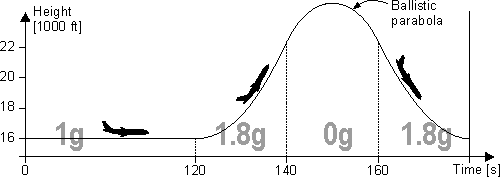
"Flash&Splash" team, officially affiliated with the Cavitation Research Group at EPFL (École Polytechnique Fédérale de Lausanne, Switzerland),  has conducted a series of experiments of fundamental research on bubbles on the parabolic flights. Water drops with centimetric diameters were produced by the micro-gravity platform (Obreschkow et al., 2008, p.15). An electrode was used to generate cavitation bubbles. The shock wave propagation in this confined water drops was visualized and studied. Bubble collapse under variable gravity was also compared.


Parabolic flights by Airbus A300 zero-g managed by European Space Agency (ESA). From Flash & Splash. Link Also refer to Obreschkow et al. (2008, Fig.1a).


Cavitation bubbles inside water drops in microgravity. Obreschkow et al. (2007). Download link


Cavitation bubbles in variable gravity. From EPFL webiste Link. Also refer to Obreschkow et al. (2011).

Based on the data of bubble sonoluminescence collected on parabolic research aircraft of NASA, Tom Matula (Applied Physical Laboratory, University of Washington, USA) concluded that the sonoluminescence intensity increases in microgravity.


References
Matula, T.J. (2000). Single-bubble sonoluminescence in microgravity, Ultrasonics, Volume 38, Issues 1–8, March 2000, Pages 559–565.
Obreschkow, D. et al. (2011). Universal Scaling Law for Jets of Collapsing Bubbles, PRL 107, 204501 (2011). pdf
Obreschkow, D. et al. (2008). Microgravity experiment: The fate of confined shockwaves, Proceedings o WIMRC cavitation forum 2008, July,7-9, Coventry, UK, pp.15-19.
Obreschkow, D. et al. (2007). Cavitation bubbles inside water drops in microgravity, APS DFD Movie contest.

Supersonic phenomenon in the kitchen

According to a recent study (Gekle, et al., 2010), one can make a supersonic air jet flow by just dropping a solid object into water in the kitchen. The "jet" to scientists usually refers to a high-speed flowing column of material (e.g. air or water). The jet is quite common in daily life e.g. water out of a hose for cleaning. The aircraft is usually pushed forward by a supersonic air flow out from the back of engine, termed turbo-jet.

When we drop a heavy solid object into a liquid (e.g. a marble into a bowl of water), three jets will be generated during the process (Lathrop, 2010): one of upward supersonic air jet, an upward water jet and a  downward water jet toward the object (e.g. marble in this case). When the air escaping through the "neck" formed during this process, it can be greatly accelerated even to supersonic flow by the pressure difference between the collapsing cavity and outer space (Gekle, et al., 2010).


The impact of a heavy object on a fluid surface causes a sequence of events leading to the creation of three jets. From Lathrop (2010). Link


In Gekle, et al. (2010), a carefully controlled disk is used. The disk  is pushed into the water with certain speed and the whole process was recorded using high-speed camera. The physical process is similar like those described above. Fine smoke particles were used to measure the speed of the air flow. Disk with different shapes were also used to study the collapse of non-symmetric cavities (Enriquez et al., 2010).


Supersonic air flow. From Gekle et al. (2010, Fig.1). 


Collapse of non-symmetric cavities. From Enriquez et al. (2010). Link


Recorded sequences from the top of disk during collapse of non-symmetric cavities. From Enriquez et al. (2010). More information is available on the website of Physics of Fluids Group, University of Twente, Netherlands. Link

You can try it in your own kitchen!

References
J. Eggers and E. Villermaux, Rep. Prog. Phys. 71, 036601 (2008).
Enriquez, O.R. et al. (2010). Collapse of nonaxisymmetric cavities, Phys. Fluids 22, 091104. Link
D. P. Lathrop, Making a supersonic jet in your kitchen, Physics 3, 4 (2010). Link
S. Gekle, I. R. Peters, J. M. Gordillo, D. van der Meer, and D. Lohse, Phys. Rev. Lett. 104, 024501 (2010).
S. Gekle, J. M. Gordillo, D. van der Meer, and D. Lohse, Phys. Rev. Lett. 102, 034502 (2009).

Wednesday, 23 May 2012

A list of articles about amazing bubble world

Here, a list of articles published on this blog are given, sorted and updated for reader's convenience.

Fundamentals

Classifications of cavitation
Rectified diffusion
Bubbles in micro- or zero- gravity
Antibubbles
Sonochemistry
Sonoluminescence
Bubble collapse near boundaries
Bubble dynamics in da Vinci’s manuscript: Leonardo's paradox

Daily life

Supersonic phenomenon in the kitchen
Soap bubbles

Technologies
Cavitation-effect lithotripsy
The use of ultrasonic cavitation for kidney stone crush
Ultrasound contrast agent
Magnetic bubbles
Ultrasonic degassing in molten alloys
Cavitation in fluid machinery
Super-cavitation
Marine life
Dolphins and bubbles
Cavitation induced by snapping shrimp
Humpback whale's bubble net
Whales' stranding: the role of bubbles


Others

Write with bubbles
Bubbles in galleries and poems


Cavitation-effect lithotripsy

Chinese version

Extracorporeal shock wave lithotripsy (SWL) is a currently widely used non-invasive treatment of kidney-, gall- and bladder- stones, using thousands of focused shock waves generated outside body to smash stones into small fragments which can naturally pass through the urethra. The shock wave source with a water-filled coupling cushion contacts the body directly. This technique was initially developed in 1980 by Dornier Medizintechnik GmbH (now Dornier MedTech Systems GmbH), Germany and has been widely spread since the introduction of the first commercial lithotriptor Dornier HM3 in 1983. There are many mechanisms for the stone fragmentation during SWL, e.g. direct stress, cavitation and fatigue. In this article, only cavitation effect during lithotripsy is briefly introduced. The drawbacks of SWL are also discussed and some alternative techniques for stone crush are introduced.

Numerous studies have confirmed the cavitation effect during lithotripsy. Generally speaking, cavitation plays an important role for the generation of small stone fragments during lithotripsy. Micro-size gas bubbles can be generated due to the presence of the weak spots within biological systems or the passage of the previous strong shock waves. The bubble nucleus are compressed by the compressive part of the shock waves and then expand dramatically generating an intense spherical shock wave, which may significantly influence the behavior of surrounding bubbles and stones. Finally, the bubbles near the stone interface collapse, forming high-speed micro jet with strong erosion ability to fragment the stones.


From left to right: a typical shock wave profile for ESWL; kidney stone before and after ESWL. Adapted from Crum et al. (2008, Fig.1).


Details of bubble cluster collapse at the proximal face of a stone. From Pishchalnikov (2003, Fig.3)

It should be emphasized that if the deliver rate of the shock wave is too fast corresponding to high pulse repetition frequency, energy of shock waves could not be delivered to the stones because of the shielding effects of the bubble cloud, i.e. dissipations of energy through bubble oscillations, generated by previous shock waves.


Fragments of stones after ESWL with different pulse repetition frequency. Adapted from Crum et al. (2008, Fig.2c).

Drawbacks of shock wave lithotripsy are:
  1. SWL could cause many adverse effects e.g. haemorrhages, hypertension, thrombi. It may also lead to long-term damage of the kidney.
  2. The treatment may be uncomfortable and cause pain to the patient if the stone is positioned near a bone or rib because of a mild resonance caused by the shock waves.
  3. The further development of this technique is limited during the past several decades. Comparing with the first commercial lithotriptor Dornier HM3, the other lithotriptors do not show remarkable extra effectiveness.
  4. For large stones (e.g. >10mm), the fragments after SWL are still too large to pass urethra naturally.
  5. Although SWL is effective to treat kidney stones, it has not received general acceptance for treatment of other types of stones (e.g. gallstone, salivary stone).
Nowadays, the use of SWL is waning especially in Europe and USA and many other techniques have been developed e.g. pyeloscopy. As a minimally invasive technique, pyeloscopy inserts a flexible thin fibre-optic telescope (diameter less then 3mm) into the kidney from the bladder via the urethra. The whole kidney system can be visualized. The laser fibers can efficiently smash stones and micro-baskets retrieves the resulting stone fragments. This technique is applicable to the kidney stones up to 20mm in size.


The passage of pyeloscopy. Source

An emerging non-invasive technique using the cavitation generated by the carefully controlled focused ultrasonic waves is being developed (Link in this blog). The strong erosion ability of cavitation cloud during collapse can shatter the stones into much fine powder (approximately <1mm), which can be easily put out of human body.

References
Crum et al. (2008). Cavitation and Therapeutic Ultrasound, Proceedings of WIMRC Cavitation Forum 2008, University of Warwick, UK, pp.10-14.
Leighton, T.G. and Cleveland, R.O. (2009). Lithotripsy, Proc. IMechE Part H: J. Engineering in Medicine, vol. 224, 317-342.
Matsumoto, Y. (2006). Therapeutic application of acoustic cavitation, Proceedings of WIMRC Cavitation Forum 2006, University of Warwick, UK, Chap.3, pp.27-35.
Pishchalnikov (2003). Cavitation Bubble Cluster Activity in the Breakage of Kidney Stones by Lithotripter Shock Waves, J Endourol.September, 17(7): 435–446.

Sunday, 20 May 2012

Dolphins and bubbles

Chinese version

Playing with bubbles is an important part of dolphins' life. It is well known that dolphins enjoy riding waves (e.g. those generated by boats) and jumping between the two bow waves of a moving catamaran.


Bottlenose Dolphin surfs the wake of a research boat on the Banana River near the Kennedy Space Center.From Wikimedia Commons.

Dolphins can also create and manipulate bubbles and show a complex behavior during their play with bubbles. The bubbles generated by dolphins  mainly include: bubble stream, bubble burst, bubble cloud, single bubble trail, (sing or double) bubble ring (McCowan et al., 2000). Dolphins can play interactively with those bubble through biting bubbles, swimming through the bubble rings and manipulating the bubble ring using their rostrum (e.g. turning the ring in a vertical fashion). More sophisticated behaviors has been observed during dolphin's play with bubbles, e.g. generation of a second bubble ring which joins the first bubble ring to form a larger bubble ring; generation of the third bubble ring passing through the second ring to catch and join the first ring.


Bubble ring generated by a dolphin. Source


Bubble ring made by a dolphin in the aquarium. From YouTube.


Bubble stream generated by a dolphin. From YouTube.


A burst of bubbles from dolphin blow hole. Source.

Both wild and captive dolphins can blow bubble rings. Sometimes, the size of the bubble ring can be large enough for dolphin to swim through. More interestingly, blowing bubble rings takes practice i.e. those dolphins who can not blow bubble rings can learn it after watching others and taking experiments (Walke, 2008, p.30video). How smart dolphins are! It has been reported by BBC that two beached whales in New Zealand were rescued by a bottlenose dolphin. 


A dolphin passing through the bubble ring. Source.

Although dolphins are talented swimmers, it has been observed that the swim speed of dolphin is below 54 kilometers per hour near the surface. According to a recent study by Iosilevskii and Weihs (2008) (also reported by New Scientist), it is cavitation which limits the speed of the dolphin. Based on a series of calculations, they found that cavitation bubbles could be formed near the tail of dolphin due to the movement of the fins. When the generated bubbles collapse, they will cause damage to the dolphins. Cavitation happens when the speeds of dolphins reach 36 to 54 kilometers per hour near a few meters of the water surface. Different with bony tail of tuna without nerve endings, dolphin can feel the pain if they swim too fast. 

References
Iosilevskii, G. and Weihs, D. (2008). Speed limits on swimming of fishes and cetaceans, J. R. Soc. Interface, 5, 329-338. doi: 10.1098/rsif.2007.1073
McCowan et al. (2000). Bubble Ring Play of Bottlenose Dolphins (Tursiops  truncatus): Implications for Cognition, Journal of Comparative Psychology, 2000, Vol. l14, No.1, pp.98-106.pdf
Walke, S.M. (2008). Dolphins, Lerner Publishing Group.